Coasts
Hilo in the Wet Season, and Why I Stopped Apologising for It
Nine days on the rain side of Hawaii Island in February, where the forecast is always the same and the town has arranged its whole life around that fact.
May 2, 2026 / Hilo, Hawaii Island / Wet season / 10 min
Filed under
Coasts
Written by
Marin Krueger
Published
May 2, 2026
An independent journal with nothing for sale. No booking is taken here, no money changes hands, and no carrier, hotel group or reservation service has any connection to what appears on these pages.
The forecast for the nine days I planned to spend in Hilo read the same way for all nine: rain. Not a chance of rain, not scattered showers, simply rain, with a small graphic that never changed. I went anyway, because I have learned that a forecast for a place like this is not a prediction so much as a description of the local climate written in the wrong tense.
It rained every day. It also stopped raining every day, usually several times, and the gaps were long enough to do everything I wanted to do. What the forecast could not tell me is the thing that turned out to matter: on this coast rain is warm, brief, frequent, and entirely ordinary, and the whole town has arranged itself around that fact in ways that are quietly wonderful to walk through.
What the rain is actually like
I want to be precise, because the word rain is doing too much work. In February on this side of the island what falls is mostly a soft heavy shower lasting between four and twenty minutes, arriving several times a day with no discernible pattern, at a temperature that makes an umbrella feel like an overreaction. It is not cold. It does not come with wind. You get wet, you keep walking, and twenty minutes later you are dry again.
Perhaps twice in nine days it did something else: two or three hours of real steady rain, the kind that fills gutters and turns the river brown. Both times it happened overnight or in the early afternoon, and both times the aftermath was the best part of the day. Waterfalls that had been polite became loud. The air after was so clean it felt like a different substance.
The rest of the time the sky did something I still find remarkable to sit and watch. Cloud forms on the slope above town, comes down the hill, empties itself, and clears, and then another one forms behind it. From a covered porch you can see the whole cycle happen three times in an afternoon.
A town built for weather
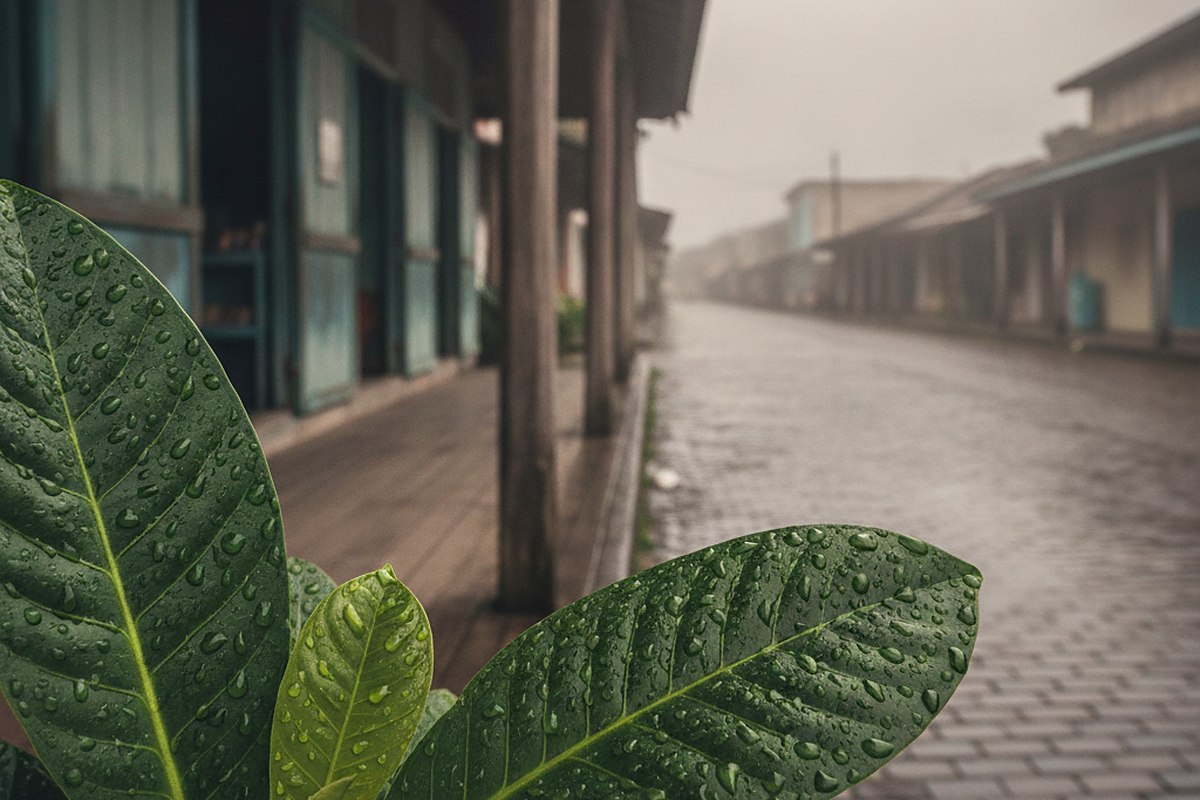
Old Hilo is a low wooden town of storefronts with deep awnings and covered sidewalks, and after two days I understood that this is not decoration. It is the reason you can spend a whole day downtown in the wet season and barely get rained on. You move along the covered stretches, and when a shower comes through you stop wherever you happen to be, which is usually somewhere with a chair.
That produced the rhythm of the whole trip. I would set out with a loose idea, get interrupted by weather, take shelter somewhere I had not chosen, and end up staying. A bookshop where the roof noise made conversation pointless for ten minutes and everyone simply waited it out together. A bakery with three tables and a queue that formed and dispersed with the rain. A covered market where the produce was stacked in a way that told you exactly which fruit was in season and which was being optimistic.
None of this is a discovery. Everyone here already knows it. But if you arrive from a place where rain cancels the day, it takes about forty eight hours to stop reading a shower as a problem, and once you do the town opens up considerably.
The bay, and mornings on it
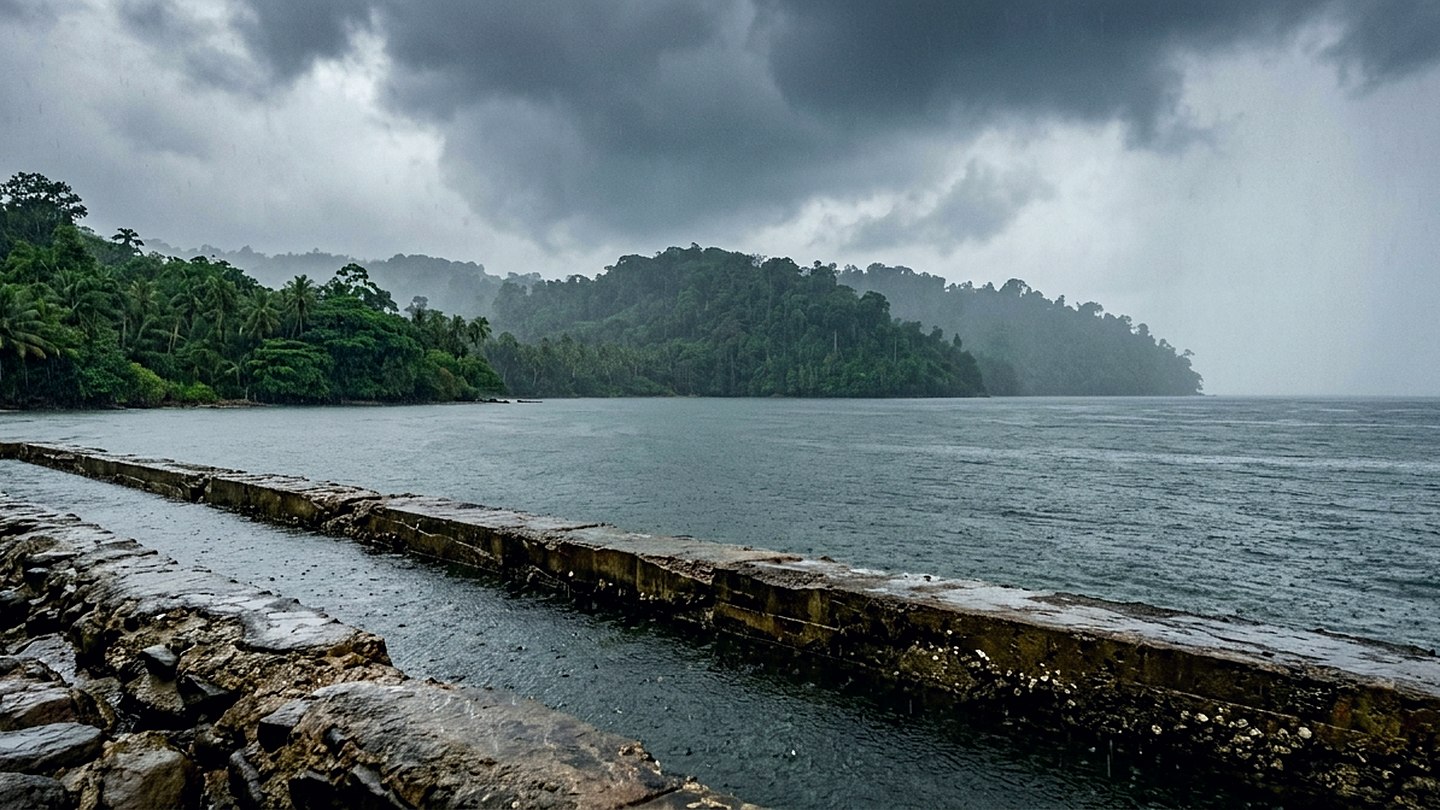
The bay is the other half of the town, and mornings belong to it. I walked the seawall most days between six and eight, which was reliably the driest window, and it was never the same twice. On calm mornings the water inside the breakwater is flat enough to hold the whole line of the mountain upside down. On rougher ones the swell comes over the wall in slow bursts and the bay turns the color of weak tea from the rivers running into it.
The banyans along the bayfront are the sort of tree that makes you stop mid sentence: aerial roots dropped from horizontal limbs, thickened over decades into a second and third trunk, the whole thing shaped by a century of exactly this weather. In flat grey light, which is what you get here most mornings, they photograph better than they ever would in sun. Grey light is not a compromise on a coast like this. It is the correct light for wet dark greens, and I stopped wishing for anything else about halfway through the week.
Rivers, falls, and the two hour rule
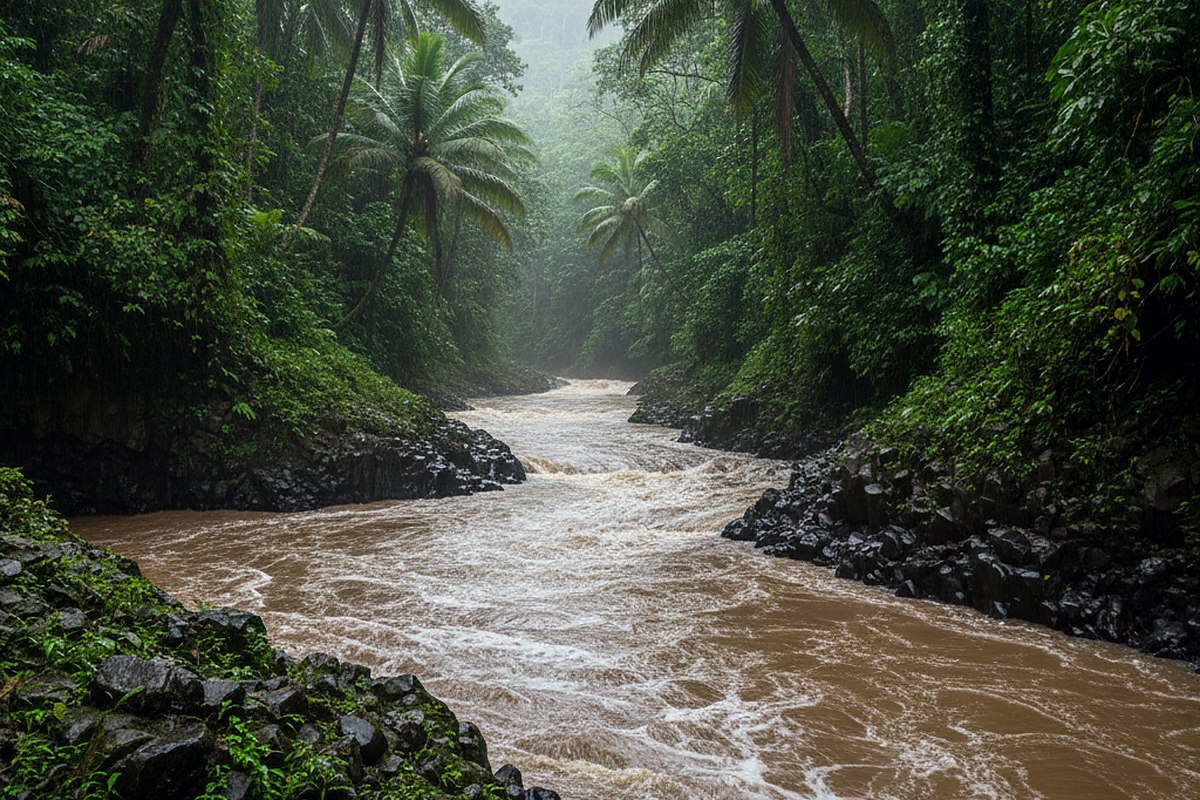
The rain side has rivers, and rivers here respond fast. A heavy shower on the slope above town shows up in the water within an hour or two, and what had been a clear pool over black rock becomes a brown push with standing waves in it.
That produced the only real technique I picked up on this trip. If you want falls at their most impressive, go about two hours after a solid squall. If you want the pools clear and green, go on the second dry morning after one. The two states are entirely different places and the schedule is set by weather rather than by you.
I will say the obvious thing plainly, because water here is not a set piece. Rivers rise quickly and without warning from rain you cannot see falling somewhere upstream. Where a stream crossing is signed as dangerous, it is. Where the county has closed an access point, it stays closed until they say otherwise. I turned back twice in nine days, once from a trail that had turned into a stream and once from a lookout where the wind was pushing the fall sideways onto the path, and both were straightforward decisions that cost me nothing but an hour.
What to bring, and what to leave
Almost everything I packed for rain was wrong. The waterproof shell was too hot to wear at these temperatures, so it stayed in the bag after the second day. The umbrella was useful in town and useless anywhere with wind or foliage. What I actually used was a wide brimmed hat, a shirt that dried fast, and shoes I had already decided I did not mind ruining.
Take two pairs of shoes so one can be drying while the other is wet, and accept that neither will ever be completely dry again until you leave. Put anything electronic in a sealed bag inside the day bag, not because of downpours but because of the constant soft damp, which gets into everything given a week. A microfibre cloth in the pocket earns its place ten times a day if you are carrying a camera, because the front element fogs and beads continually and half of my unusable frames from the first two days had a drop I did not notice.
Leave behind the expectation of a blue sky photograph. You may get one. I got about ninety minutes of clear sky across nine days, on the seventh afternoon, and I remember being almost annoyed by how ordinary the light was.
Would I go back in February
Yes, and specifically in February rather than in the dry months. The greens are at their most saturated, the falls are running, the town is not crowded, and the whole place is doing the thing it is actually built to do rather than performing a dry season version of itself.
There is a version of this coast that people go looking for and mostly do not find: sun, blue water, a beach day. It exists, on the other side of the island, and there is nothing wrong with wanting it. But the rain side rewards a completely different appetite. It is green, slow, quiet, and constantly moving, and it asks only that you stop treating the weather as an obstacle between you and the trip. Once I did that, the trip started on the third morning and did not stop.